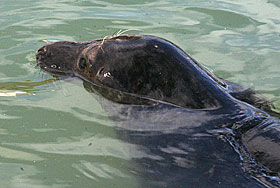
Stinkweed was rescued on 4th October 2009
|
Our first pup from the RSPCA has arrived for its rehabilitation with other seals.
This pup named "Stinkweed" (RSPCA chose to name their pups after wild flowers and plants) was rescued on the 4th October 2009 from Puttsbrough in Devon, this pup was malnourished and weighing only 13 kilos, with wounds all over its body which were infected.
The pup was given a course of antibiotics and wounds cleaned and treated.
Stinkweed´s flipper tag number is 80000 (orange).
| 
|
|
On Wednesday 18th November 2009, this pup was transferred to the Sanctuary and is now in nursery pool 3.
|
 |
Update: 2nd January 2010 - Stinkweed now weighs 41.5 kilos.
Update: 28th February 2010 - This photo of Stinkweed was taken on 27th February 2010 in the pup pool with Dolores and Ginny. Click here to see further photos.
Update: 22nd March 2010 - Stinkweed along with Ginny and Dolores were released back
into the wild on 2nd March 2010 at Gwithian.
|
Update - 27th June 2014 : Anna Cawthray from the Scilly Seal Snorkelling in the Isles of Scilly, had left a message on the
Cornwall Seal Group
facebook page saying she had seen a seal which she thinks is Stinkweed with tag number 80000. Sue Sayer of the Cornwall Seal Group confirmed that indeed this is Stinkweed.
Click here to see a large photo of Stinkweed taken by Anna Cawthray.
|

|
 |
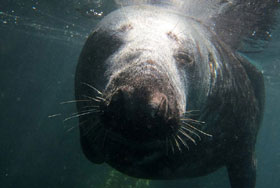
Update - 20th July 2014 : Stinkweed came out to play again on 13th July 2014, he was seen by Anna Cawthray from
Scilly Seal Snorkelling
in the Isles of Scilly. He seems to be enjoying playing and blowing bubbles at the camera.
Click here to see a larger version of the photo of Stinkweed taken by Anna Cawthray.
|
Update - 29th December 2020 : Stinkweed was spotted at haul-out along the coast of Cornwall on 2nd & 20th May 2013, 22nd July 2013, 23rd August 2013 and 29th December 2020 by members* of the Cornwall Seal Group Research Trust (CSGRT).
Members of the
CSGRT volunteer hundreds of hours of their own time to photo, identify, carry out surveys, monitor and watch over the seals around the Cornish coast.
Each seal´s fur pattern is unique and enables the CSGRT volunteers track them for life.
Seals face many challenges, yet we all depend on them to balance our marine ecosystem, this is essential to make the
oxygen we breathe. Seals are our globally rare wildlife tourist attraction, helping diversify coastal economic prosperity.
|
|